

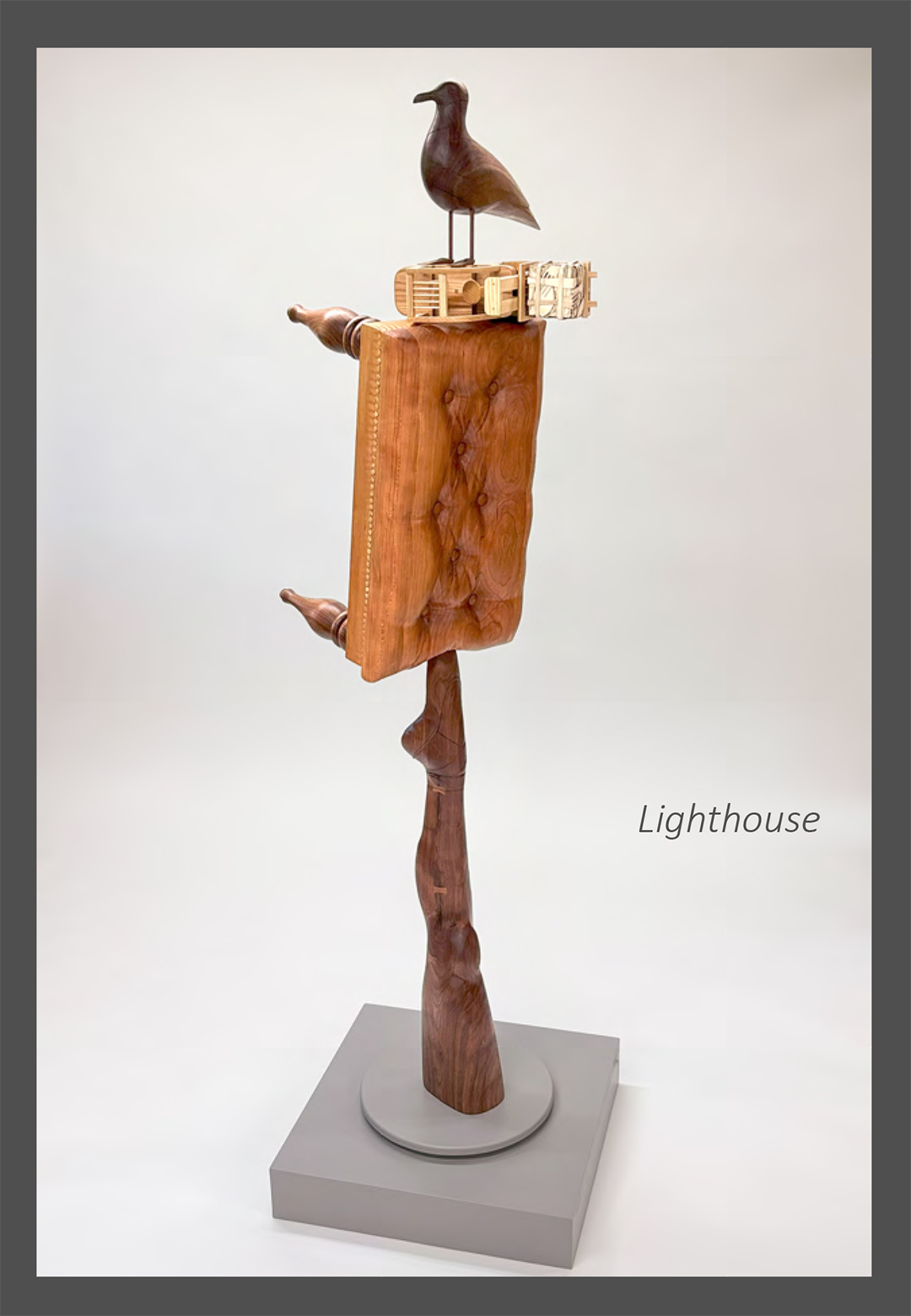
Lighthouse
Notes on the Title
The title Lighthouse arose not in relation to Emma (see notes on conception) but actually from seeing the ballerina leg in its upside down orientation on the floor underneath a drawing of a lighthouse by my paternal grandfather. Entitling it Lighthouse provides one interesting conceptual direction in navigating an experience of this stack of wood.
I will not pretend to have a certain or even a very clear understanding of what the idea of a lighthouse does as the title of this piece. I do know that as a lamp on the coastline, a lighthouse is a beacon for discerning the edge of the land (either safe harbor or dangerous coastline) as seen from the water. That’s obvious, but I do see value in considering an inversion to the standard metaphor; a lighthouse is a beacon indicating the edge of the vastness. At no time have I been crossing a body of water and felt the relief of seeing a lighthouse. I have stood on the shore and looked out at the vast ocean and felt the unknown immensity. My experience of lighthouses has always been as seen from the parking lot on the land side.
Lighthouses have an important function and are still relied upon by sailors today. However, my feeling is that on average we don’t experience them in the same manner now that navigation is on a screen and long distance travel for passengers is in the air. So for the majority of us, they have become family photo-op destinations with attractive, somewhat romanticized, technological artifacts. In it’s prime, the lighthouse on the coast marking the edge of land was something to be discovered when the destination unfolded in the present; the end wasn’t on the GPS screen from the beginning of the voyage. This kind of unknown was necessarily lived with as part of the experience of traveling over the vast ocean. We don’t need to abandon these ideas in order to effectively, beneficially, invert the lighthouse metaphor. In this inverted looking-out-at rather than looking-in-at sense, a lighthouse marks the end of something (the known) and the beginning of the unknown vastness. Thus, Lighthouse is a warning sign or a welcome sign that nothing is ahead.
Notes on the Material
• Five species of wood: walnut, ash, red oak and holly.
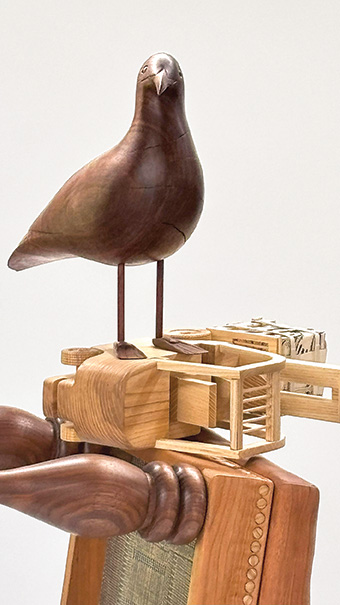
• The ballerina leg and the seagull are made of walnut.
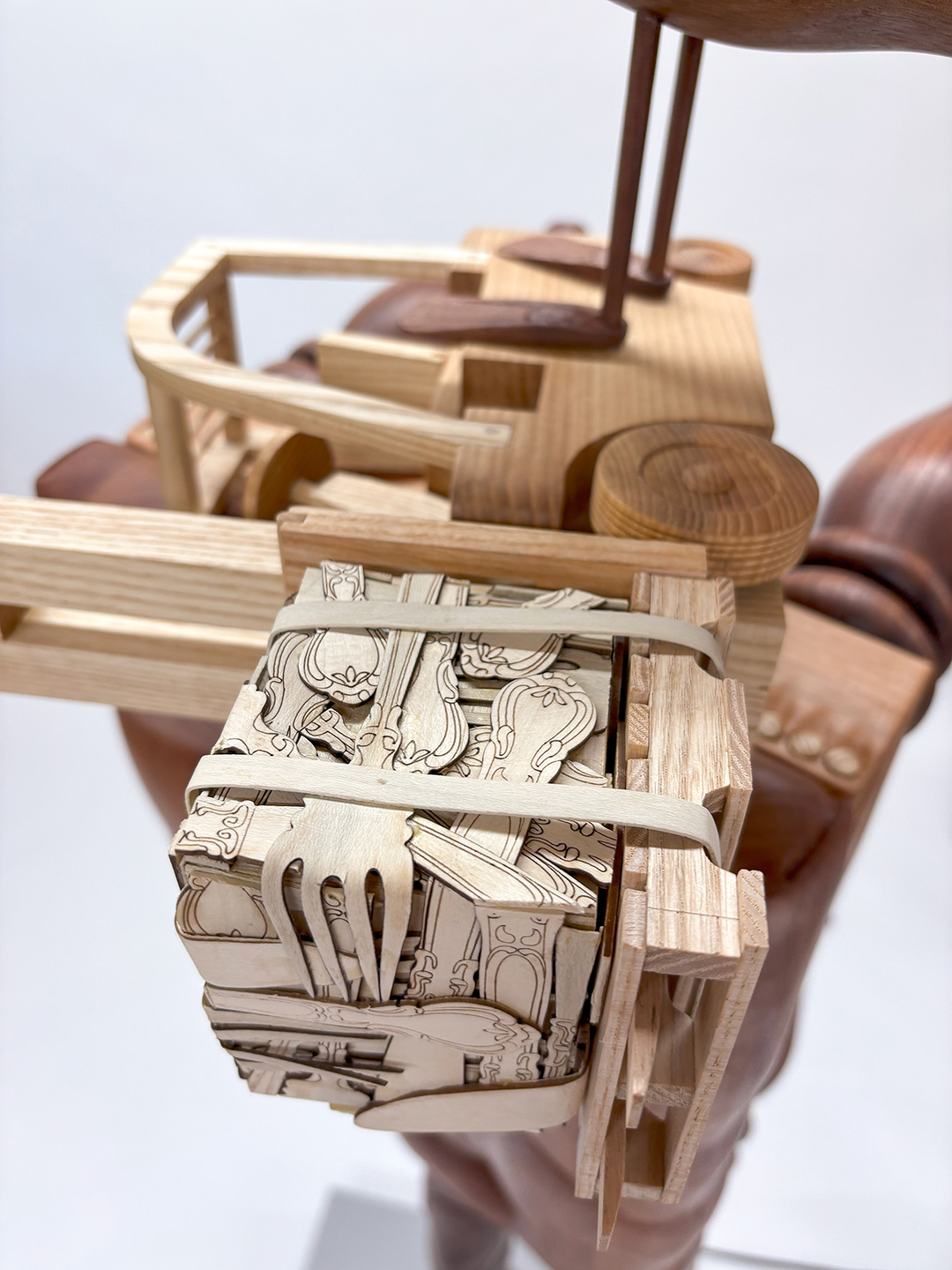
• The forklift and the pallet are made of ash.
• The recycling bale of silverware is made of holly.
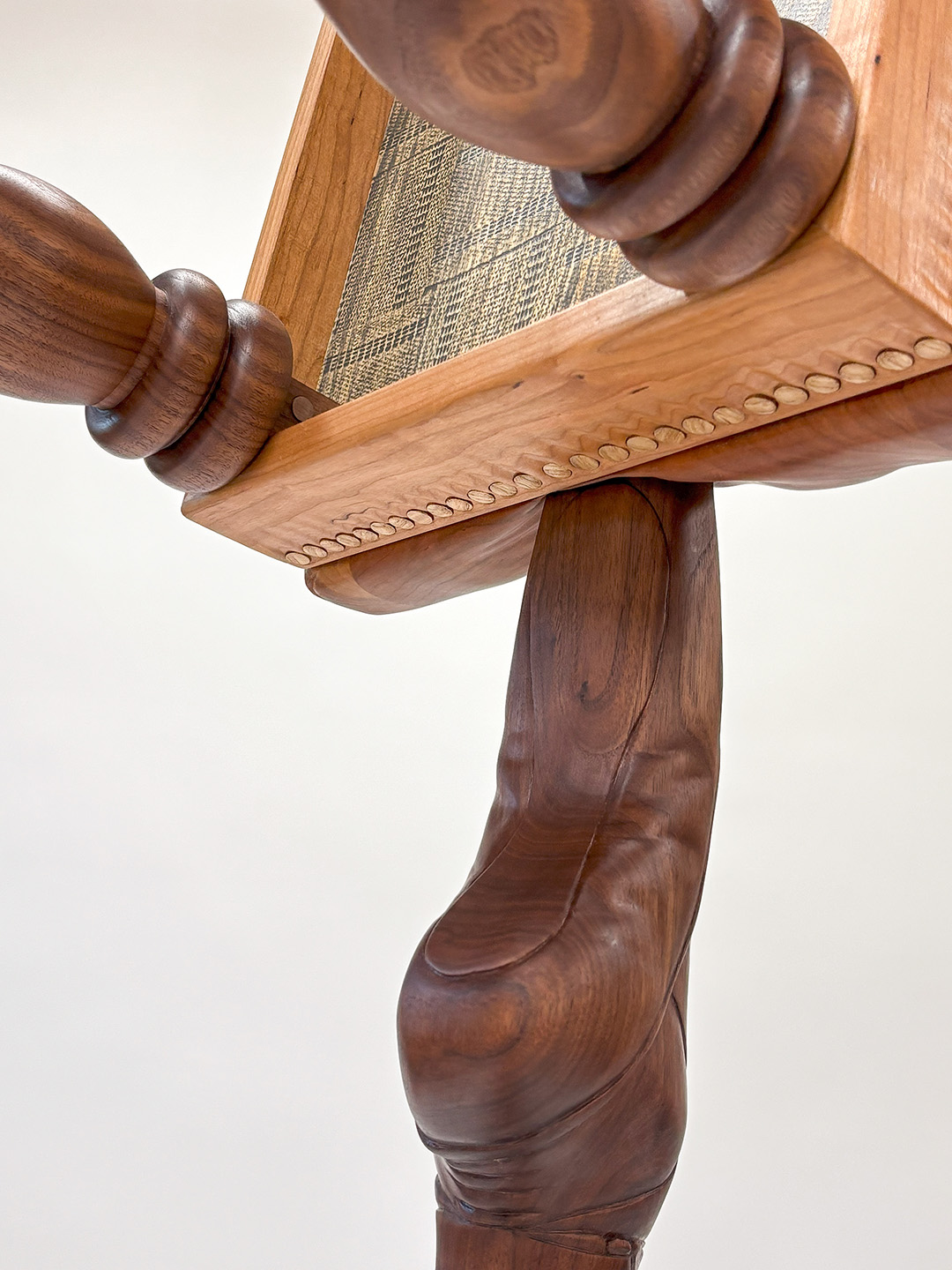
• The upholstery “leather” on the ottoman is cherry, the nails
are red oak, the legs are walnut and the jute strapping is ash
Notes on the Composition
• Gravity is an important aspect of Lighthouse, and the piece is balancing on its own. There are wooden pins and one screw only for safety in a public setting. The circular part of the base pedestal rotates the sculpture at one revolution per minute.
• What might be considered the normal “down” direction is different for each of the four primary components.
• The ballerina leg was stabilized with butterfly wedges (also called bowties or butterfly keys). There are eight butterflies inserted into the leg at a depth of about 3/8”. Their purpose is to keep the checks (cracks) from growing larger. The leg is carved from a piece of walnut with the pith (the center of the tree) as part of it. It is standard woodworking practice to avoid the pith as it is a structure like a drinking straw in the middle of the tree that presents as a void (a flaw) when carved into. Checks extend outwards from the pith as the log dries and shrinks. Using this piece of wood was going to be a risk, and as it was being carved, checks on the lateral sides of the leg became obvious. Butterfly wedges were needed to prevent these “flaws,” which do not affect the structural integrity of the piece, from growing more visibly significant. There are 7 visible wedges while the 8th is in the tip of the pointe shoe.
• The piece of walnut in which the seagull was carved had no pith, however it did have some small checking on one end. In laying out the seagull form, my intention was to avoid any checking, and after bandsawing off large sections it appeared almost check free. I hoped they were superficial and would not extend deeper into the piece. However, about halfway through the carving process it became clear that this wasn’t going to hold. The end grain on the breast of the bird was moving, checking. The leg was by this point stabilized with butterfly wedges and a powerful relationship I had not considered presented itself: attempting to control wood movement in the leg vs. allowing the wood of which the bird was carved to check as nature would have it.
Notes on the Conception
While it’s not essential for experiencing Lighthouse, my daughter Emma’s life shaped many of the decisions that were made. I had a general vision for the piece; however, many loose variables needed filling: what species of bird to use, the finished title, what would be the object between the ottoman and the bird (the ideas I had didn’t quite work yet), and which species of wood to use. The first step I felt comfortable taking was to design and build a tufted ottoman on a ballerina leg. Leg carving began, and I would let the rest percolate for the couple of weeks it would take to get it roughed out and joined with the upholstered ottoman top. At this time, Emma was having her second ACL surgery on her right knee. And since butterfly wedges were a necessary intervention (surgery) for controlling the checking in the ballerina leg, a connection to Emma came to mind.
Around the same time, on a trip to Seattle, a seagull landed on our window sill for a rare photography session; a seagull plays a starring role in a family story. During a family vacation to the beach when our kids were quite young, a daring seagull traumatized Emma by snatching a saltine cracker directly out of her hand. Since then, every seagull we encounter is named Cracker. How could I not put Cracker in the top spot?
The major pieces were almost all in place except for the object to be stacked between the bird and the ottoman. It came to mind that I have never seen Emma so proud of an accomplishment as when she became forklift certified for her job at a construction materials company. The forklift became the obvious choice: when scaled down it could have a wooden-toy aspect, a palletized object would add new unconceived relationships, and ultimately a forklift’s functionality would create a meaningful contrast to a Baroque ottoman and ballerina leg. It had to be a forklift!
Ultimately, there will be wide ranging experiences of this piece. In one of them, I am saying to Emma: “my beautiful daughter (who danced in the Nutcracker as a child, who is now forklift certified, and from whom a seagull snatched a cracker) I am so proud of your balancing the vicissitudes of life.”